Impact, Support, and the Weight ERG Leaders Carry
Last week I shared some of the broader shifts happening with ERGs (from research from Seramount). ERGs are changing and adapting but not disappearing. (Next week, we’ll be back to the FAIR Model!)
The same webinar shared this slide.
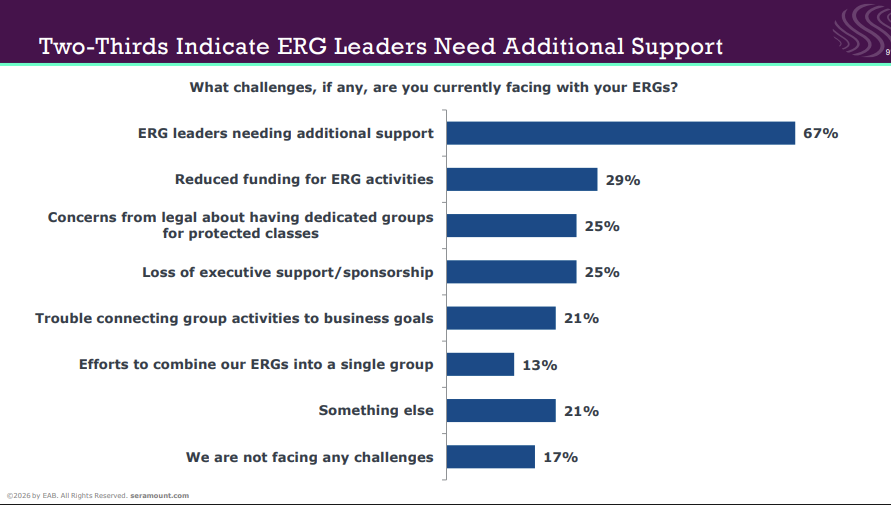
This slide shows us that most ERGs are operationally strong with clear missions, thoughtful programming, and leaders who figure out how to make something meaningful with very little. HOORAY!!!!!
But another slide showed where the gap tends to appear.
Impact.
Especially when it comes to workforce and business outcomes.
And then, almost in passing, they shared that a large percentage of leaders say ERG leads need more support. OOF.
ERGs are being asked to demonstrate business value. Individual leaders are being asked to carry work that is relational, emotional, strategic, and sometimes quietly political. It lives on top of their primary role. They are asked to read a (often cold) room, protect trust, navigate ambiguity, and translate community needs into language executives understand.
And when growth levels off, and no one is quite sure why, it seems likely to me that it is NOT because ERGs lack commitment or vision.
It may be because we haven’t fully acknowledged what we’re asking of the people leading them.
They are asked for measurable outcomes, alignment to business strategy, and workforce impact. But has the scaffolding that makes that sustainable been built?
If you’re struggling to articulate the support you need, you might try saying:
“For our ERG to drive measurable impact, we need clarity on X, authority over Y, and support in Z.”
“For our ERG to influence retention or engagement, we need access to this data.”
“For our ERG leaders to sustain this level of strategic contribution, we need shared leadership or formal recognition of the time required.”
Clarity changes the conversation.
Weekly Reset
Before you craft the “professional” version of the support you need…
Write a wildly exaggerated one first.
“For our ERG to succeed, we need a private jet, a 14-person analytics team, the CEO on speed dial, and a company black AmEx.”
(This is a spin on Worst First brainstorming, where you come up with several truly terrible ideas before starting to think of good ones)
As you continue building and refining your ERG, if you find yourself in need of programming or facilitation support, I’d be honored to partner with you. The work we do together is energizing, grounded in neuroscience, and designed to actually shift something and not just fill the calendar.