“Trying to define play is like trying to define love.”
I recently came across this quote from Gordon Sturrock (shared in writing by Penny Wilson), and I immediately saved it because it captures something I run into constantly in this work.
If you've attended one of my workshops or webinars, you've probably heard me talk about my functional definition of play. It’s not really a definition in the traditional sense. It’s more a collection of characteristics pulled from a LOT of research across neuroscience, psychology, education, and play studies — Peter Gray, Gökhan Güneş, Stuart Brown, the LEGO Foundation, René Proyer, and many others.
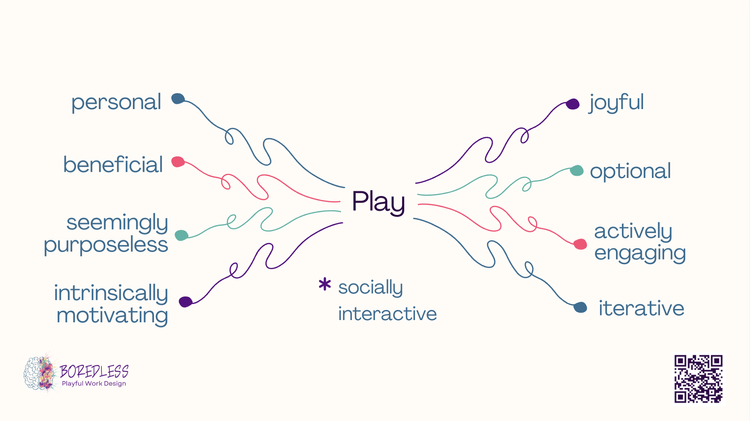
The common threads across all of that research suggest that play is:
joyful, personal, beneficial, optional, intrinsically motivating, actively engaging, iterative, seemingly purposeless, and sometimes social.
And honestly, even after all of that research, I still think Gordon Sturrock was right. Play is hard to define because it is deeply human and deeply personal.
Which is exactly why I get so frustrated when people assume play at work means forced fun, improv, office olympics, mandatory games, or awkward icebreakers.
Most adults do not hate play, most of us hate being forced into someone else’s version of it. That’s a HUGE difference.
Playfulness can look wildly different from person to person. For one person it might be improv, storytelling, or brainstorming out loud. For someone else it might be organizing ideas, making connections between concepts, doodling during meetings, building spreadsheets for fun, collecting random facts, or wearing bright purple patterns because it makes your brain happy.
This is why I love the Personal Play Identity framework developed by René Proyer and Kay Brauer. It gives people language for the ways they naturally experience playfulness.
You might be:
Lighthearted — spontaneous, flexible, and carefree (this is what most people think of when they hear the words play or playfulness)
Relational — playful through humor and connection with others
Intellectual — playful with ideas, concepts, and problem-solving
Whimsical — drawn to novelty, imagination, and unconventional experiences
Understanding your own play patterns can completely change the way you approach work, creativity, collaboration, and even rest. It also helps teams stop assuming everyone recharges, communicates, or engages in the same way.
And that matters because play is not extra. It’s not childish. It’s not something we “earn” after productivity.
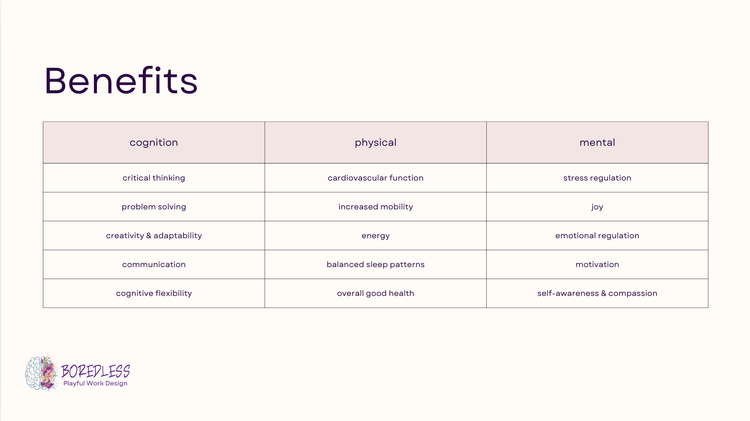
Play supports creativity, resilience, problem-solving, learning, communication, innovation, and overall well-being… and more. Biologically and physiologically, it is part of being human.
So if you’ve ever thought “play just isn’t for me,” I’d encourage you to consider that maybe the issue isn’t play itself.
Maybe you’ve just been handed versions of play that never actually fit you.
If you want to explore your own Personal Play Identity, reply to this email with the word PLAY and I’ll send you some resources to get started. (or just click here!)
And if your team is struggling with burnout, disengagement, or feeling disconnected from one another, this work can help there too. I’d love to bring one of my workshops into your organization!